


Vial Setup
Dose
Draw volume results
How to use this peptide calculator
Enter your vial size in mg (the total peptide content printed on the vial), the volume of bacteriostatic water in mL you added during reconstitution, and your desired dose in mg or mcg. The calculator instantly shows your draw volume in mL and the equivalent units on a standard 100-unit insulin syringe.
Works for all reconstituted peptides: BPC-157, TB-500, CJC-1295, Ipamorelin, PT-141, Selank, Epitalon, semaglutide, tirzepatide, Tesamorelin, DSIP, GHK-Cu, and high-dose vials like NAD+ 500 mg / 1,000 mg.
Frequently asked questions
How many units do I draw for a peptide dose? +
Units depend on your concentration. The formula is: draw volume (mL) = dose (mg) ÷ concentration (mg/mL), then multiply mL × 100 to convert to units on a 100-unit syringe. Example: 0.25 mg dose with a 2.5 mg/mL concentration = 0.1 mL = 10 units.
How much bacteriostatic water do I add to reconstitute a peptide? +
It depends on the concentration you want. Adding 1 mL to a 5 mg vial gives 5 mg/mL; adding 2 mL gives 2.5 mg/mL. More water means smaller, easier-to-measure draw volumes. Use the calculator above to find the water volume that gives you a clean, measurable draw for your dose.
What is the difference between mg and mcg for peptides? +
1 mg = 1,000 mcg. Many peptide doses are written in micrograms (mcg) — for example, a 250 mcg BPC-157 dose is the same as 0.25 mg. Switch the dose tab to mcg to enter your dose directly without converting.
How do I reconstitute a peptide vial? +
Use a fresh insulin syringe to draw bacteriostatic water, then inject it slowly along the inner wall of the peptide vial — never directly onto the powder. Do not shake; gently swirl or let it dissolve on its own. Store reconstituted peptides refrigerated and use within the timeframe recommended by your provider.
What syringe should I use to inject peptides? +
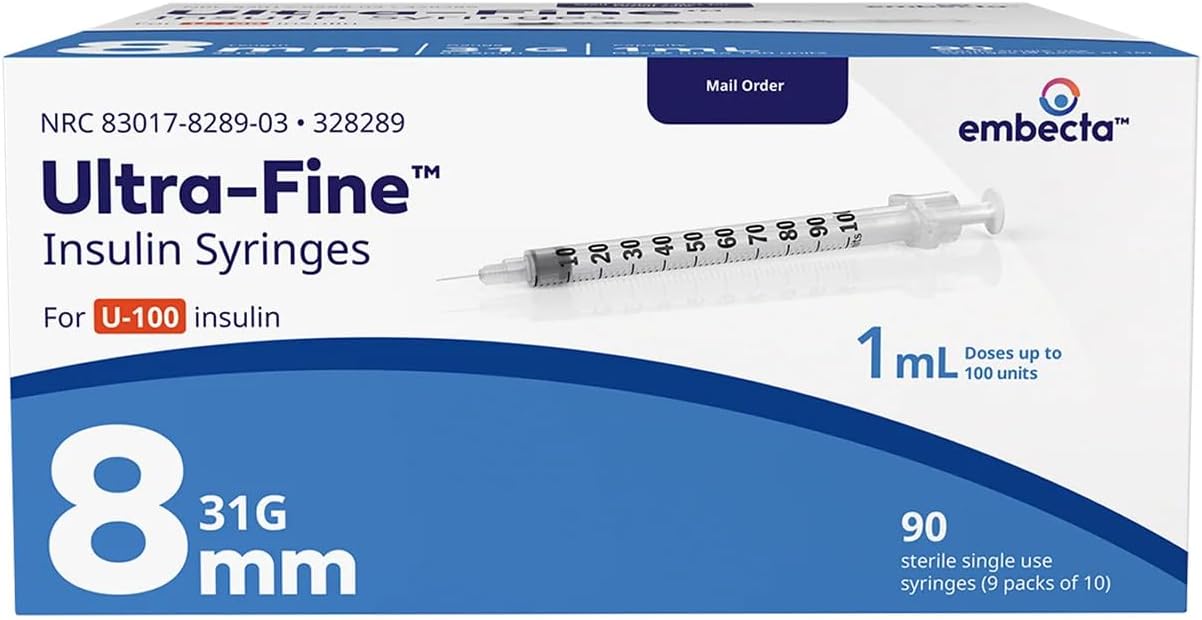
Most subcutaneous peptide injections use a 1 mL / 100-unit U-100 insulin syringe with a 29–31 gauge, 5/16" (8 mm) needle. This calculator's unit readout is calibrated to a 100-unit syringe — draw to the unit number shown in the result.
How do I store a reconstituted peptide? +
Once reconstituted, peptides should be stored in the refrigerator at 2–8°C (36–46°F) and kept away from light. Most reconstituted peptides are stable for 4–6 weeks when refrigerated with bacteriostatic water. Never refreeze a reconstituted peptide — freeze only lyophilized (dry powder) vials.
What is bacteriostatic water and why do I use it? +
Bacteriostatic water is sterile water containing 0.9% benzyl alcohol, which inhibits bacterial growth. It is the standard diluent for peptide reconstitution because it keeps multi-dose vials safe for weeks. Do not use regular sterile water or tap water — bacteriostatic water is required for safe multi-use vials.
Can I use this calculator for semaglutide or tirzepatide? +
Yes. Compounded semaglutide and tirzepatide vials work the same way — enter the vial mg, the mL of bacteriostatic water added, and your weekly dose in mg or mcg. The calculator will show your exact draw volume and syringe units. Common starting doses for semaglutide are 0.25 mg/week; tirzepatide typically starts at 2.5 mg/week.
What does concentration (mg/mL) mean? +
Concentration is how much peptide is dissolved per milliliter of liquid. It is calculated by dividing the vial size by the water added: a 5 mg vial + 2 mL water = 2.5 mg/mL. The higher the concentration, the smaller the volume you need to draw for each dose — which can make injections more comfortable.
How many doses can I get from one vial? +
Divide the total vial mg by your dose mg. A 5 mg vial at 0.25 mg per dose = 20 doses. The calculator shows this automatically in the "Doses per vial" result. This helps with planning how long a vial will last and when to order your next one.
About this calculator
PeptideCalculator.wiki is a free, independent reference tool built for researchers, clinicians, and patients working with reconstituted peptides. Our calculator uses standard pharmaceutical reconstitution math and is designed to reduce dosing errors caused by unit confusion between mg, mcg, mL, and insulin syringe units. No account required, no data collected, no cost.